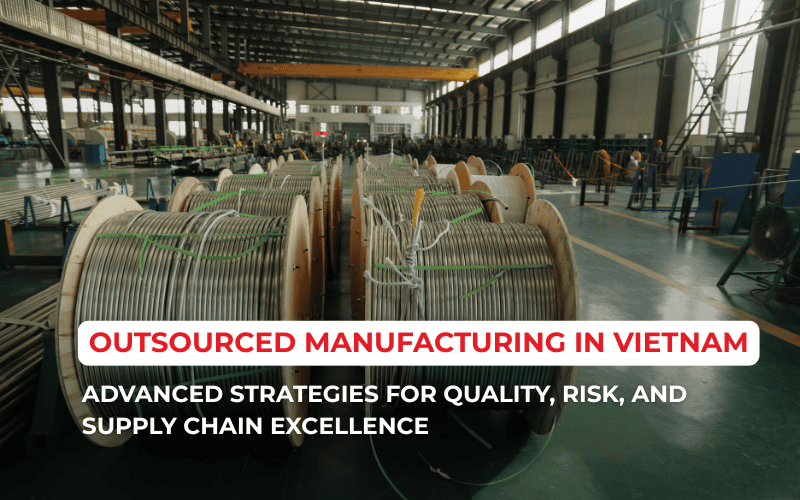
Outsourced Manufacturing in Vietnam: Advanced Strategies for Quality, Risk, and Supply Chain Excellence
Moving beyond basic outsourcing fundamentals represents a critical evolution for growing businesses. While successfully launching your first manufacturing project in Vietnam demonstrates important capabilities, achieving sustained excellence requires more sophisticated management practices.
The difference between transactional supplier relationships and strategic manufacturing partnerships often determines competitive advantage. Companies that excel at outsourced manufacturing don’t simply place orders and hope for the best—they build integrated systems for quality assurance, risk management, supplier development, and continuous improvement.
This guide targets businesses that have already established basic manufacturing operations and are ready to elevate their capabilities. Whether you’re scaling existing production, managing multiple suppliers, or seeking operational excellence, the strategies outlined here will help you build world-class manufacturing operations.
By implementing these advanced strategies, you’ll transform manufacturing from a source of constant firefighting into a strategic advantage that supports business growth and competitive positioning.
Building Robust Quality Systems for Contract Manufacturing
Moving beyond basic inspection to comprehensive quality management separates excellent manufacturers from merely adequate ones. Having your own operations when implementing contract manufacturing strategies in Asia; particularly placing a technical team on the ground to manage quality; is highlighted in this video as one of the key success factors :
Quality Management Frameworks
ISO 9001 implementation provides a foundation for systematic quality management. This standard defines requirements for quality management systems including process documentation, resource management, product realization, measurement and analysis, and continuous improvement. Companies serious about quality should either obtain ISO 9001 certification or implement its principles even without formal certification.
Six Sigma methodologies focus on reducing process variation and defects through data-driven analysis. The DMAIC framework (Define, Measure, Analyze, Improve, Control) provides structure for systematic improvement projects. Even without full Six Sigma deployment, adopting its statistical tools and disciplined approach yields significant benefits.
Total Quality Management (TQM) emphasizes organization-wide commitment to quality involving every department and employee. TQM principles include customer focus, continuous improvement, employee involvement, and process-centered approaches. While comprehensive TQM requires cultural transformation, adopting these principles gradually improves quality outcomes.
Advanced Inspection Protocols
Statistical Process Control (SPC) monitors manufacturing processes in real-time using statistical methods. Control charts track key process parameters, identifying when processes drift outside acceptable ranges before defective products are produced. SPC prevents defects rather than merely detecting them after production.
First Article Inspection (FAI) provides comprehensive verification when production begins or after any significant process changes. FAI examines every specified characteristic on initial production units, creating baseline documentation. This intensive inspection catches problems immediately rather than after thousands of units are produced.
Automated quality control systems using vision systems, sensors, and AI can inspect 100% of production at speeds impossible for human inspectors. While requiring upfront investment, automated systems provide consistency, eliminate human fatigue, and generate comprehensive data for analysis. Work with manufacturers to deploy these systems for critical quality characteristics.
Supplier Quality Scorecards
Quantified supplier performance metrics enable objective assessment and drive improvement. Key metrics include defect rates measured by parts per million (PPM), on-time delivery percentage, responsiveness to quality issues (average resolution time), and communication quality (response time, clarity).
Share scorecards regularly with suppliers—monthly or quarterly depending on production frequency. Frame these not as criticism but as shared visibility into performance trends and improvement opportunities. Best practice involves reviewing scorecards jointly with suppliers to discuss performance, identify improvement areas, and recognize excellent performance.
Establish performance tiers with associated benefits or consequences. Top-tier suppliers might receive preferred status for new products, early payment discounts, or increased volume allocation. Lower-tier suppliers face increased oversight, improvement plans, or eventual replacement if performance doesn’t improve.
Multi-Supplier Quality Coordination
Managing quality across multiple suppliers requires standardization and coordination. Develop comprehensive quality manuals that define your standards, inspection requirements, documentation needs, and defect definitions. Provide these manuals to all suppliers ensuring consistent understanding of requirements.
Conduct supplier workshops where multiple suppliers learn your quality requirements together. This approach ensures consistent messaging and allows suppliers to learn from each other’s questions and experiences.
Cross-supplier audits where quality teams visit all suppliers systematically verify consistent implementation of quality standards. Identify best practices at any supplier and encourage adoption across your supplier base.
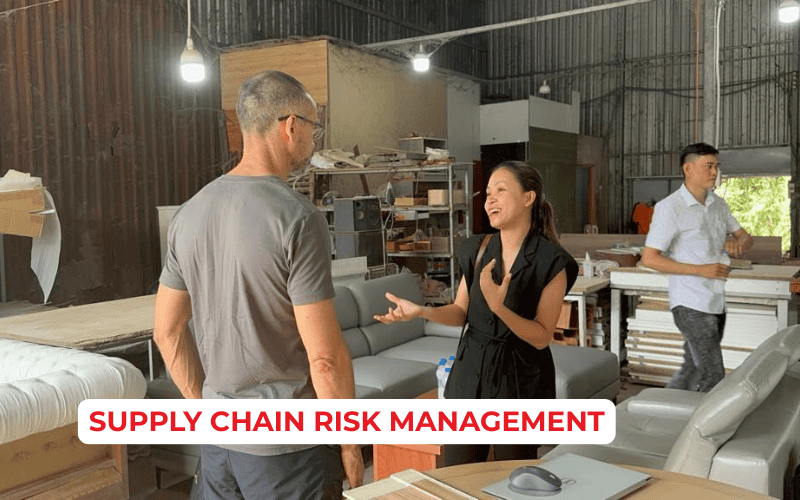
Supply Chain Risk Management
Sophisticated supply chain risk management identifies vulnerabilities proactively and builds resilience before crises strike.
Mapping Supply Chain Vulnerabilities
Complete supply chain mapping extends beyond your direct suppliers to include their suppliers of critical components and materials. Many disruptions occur at second or third tier levels where you have no direct visibility. Request supply chain information from key suppliers including their critical suppliers, geographic locations of key facilities, single-source components in your products, and lead times for key materials.
Create visual supply chain maps showing all tiers, locations, and material flows. These maps reveal hidden concentration risks—discovering that multiple suppliers actually source from the same component manufacturer or that critical materials funnel through a single geographic chokepoint.
Vulnerability assessment evaluates each supply chain node for risks including financial stability of suppliers, political and regulatory risks in locations, natural disaster exposure (floods, earthquakes, typhoons), infrastructure dependencies (ports, power, transportation), and technical complexity or specialization that limits alternatives.
Just-in-Time vs. Just-in-Case Strategies
Just-in-time (JIT) inventory management minimizes inventory carrying costs by synchronizing production and delivery closely with demand. JIT works beautifully in stable environments with reliable suppliers but creates vulnerability to disruptions.
Just-in-case strategies maintain safety stock buffers to protect against uncertainty. While increasing inventory carrying costs, these buffers provide resilience when disruptions occur.
The optimal strategy usually combines both approaches: JIT for predictable, high-volume items from reliable suppliers, and just-in-case buffers for critical items, unpredictable demand items, or items from less reliable supply chains.
Calculate buffer stock levels by analyzing historical demand variability, supplier lead time variability, criticality of the item (cost of stockouts), and shelf life or obsolescence risk. Statistical inventory models help optimize these tradeoffs.
Business Continuity Planning
Comprehensive business continuity plans define how you’ll respond to various disruption scenarios. Develop specific plans for different disruption types including supplier failure (financial collapse, quality crisis, capacity loss), natural disasters affecting production or logistics, geopolitical events (trade wars, sanctions, civil unrest), pandemics or public health crises, and cyber attacks affecting communications or data.
Each plan should identify trigger conditions that activate the plan, immediate response actions and responsibilities, communication protocols with suppliers and customers, alternative suppliers or production approaches, and recovery objectives and timelines.
Test continuity plans through tabletop exercises where teams walk through scenarios without actual disruption. These exercises reveal gaps in plans and build muscle memory for crisis response.
Supplier Redundancy and Scenario Planning
Qualifying backup suppliers for critical items creates options before crises force rushed decisions. Even if you don’t use backup suppliers regularly, maintain relationships through occasional orders or annual audits ensuring they remain viable alternatives.
Dual sourcing splits production between two qualified suppliers. While slightly increasing complexity and potentially reducing economies of scale, dual sourcing provides immediate fallback if either supplier has problems. Many companies use 60/40 or 70/30 splits maintaining primary relationships while keeping alternatives active.
Scenario planning exercises explore “what if” questions systematically: What if Vietnam closes ports due to a pandemic? What if our primary supplier’s factory burns down? What if US-Vietnam trade relations deteriorate? Develop response playbooks for high-impact scenarios even if probability seems low.
Intellectual Property Protection in Vietnam
Advanced IP protection goes beyond basic registration to embed protection throughout manufacturing relationships and operations.
Vietnam’s IP Legal Framework
Vietnam is a signatory to major international IP agreements including TRIPS (Trade-Related Aspects of Intellectual Property Rights), Paris Convention for industrial property, and Berne Convention for copyrights. The legal framework has improved substantially, though enforcement remains less consistent than in developed markets.
The National Office of Intellectual Property (NOIP) handles registration of trademarks, patents, industrial designs, and utility solutions. Registration provides stronger protection than relying on international rights. Registration timelines run 12-18 months for trademarks and longer for patents, so begin processes early.
Recent improvements include specialized IP courts with better-trained judges, stronger customs enforcement allowing border seizures of counterfeit goods, and increased penalties for infringement. However, court processes remain slow and outcomes less predictable than in developed markets.
Embedding IP Protection in Manufacturing Relationships
Comprehensive non-disclosure agreements (NDAs) should precede any sharing of sensitive information. NDAs must clearly define confidential information, permitted and prohibited uses, duration of confidentiality obligations, and consequences for breaches. Use NDAs specific to Vietnamese law or international frameworks enforceable in Vietnam.
Manufacturing agreements should include explicit IP ownership clauses stating you own all product designs, specifications, tooling, and related IP. Prohibit manufacturers from producing similar products for others, particularly for your competitors. Restrict production to authorized quantities with audit rights to verify compliance. Define substantial penalties for IP violations tied to potential damages.
Physical security measures at manufacturing facilities protect against IP theft. Require controlled access to sensitive areas, secure storage of tooling and specifications, confidentiality agreements with manufacturer’s employees, and restrictions on photography or electronic devices in production areas.
Splitting Production for IP Protection
Strategic production splitting ensures no single party possesses complete product IP. Complex products can be manufactured in subassemblies by different suppliers who each lack the complete design. Final assembly might occur at a different facility or even in your own facilities.
For example, an electronic product might have circuit boards assembled by Supplier A, plastic housings produced by Supplier B, and final assembly and programming by Supplier C. Each supplier has limited IP exposure while you maintain control of the complete product design.
The tradeoff involves increased coordination complexity and logistics costs. This approach makes sense for products with substantial IP value where protection justifies additional complexity.
Cross-Border Enforcement
Despite improvements, IP enforcement within Vietnam remains challenging. Cross-border enforcement through customs provides additional protection. Register your IP with customs authorities in your destination markets enabling border seizures of counterfeit goods.
US Customs and Border Protection (CBP), EU customs, and other major markets offer recordation programs where you register trademarks and copyrights. When counterfeit goods are detected at borders, customs can seize them before they reach markets.
Monitor e-commerce platforms and physical markets in target geographies for counterfeit products. Services exist that scan online marketplaces systematically identifying unauthorized sellers. When counterfeits are found, use platform takedown procedures and consider legal action against sellers.
International arbitration provisions in contracts provide more reliable dispute resolution than Vietnamese courts. Singapore and Hong Kong arbitration are common choices, offering neutral forums with enforceable awards under international conventions.
Strategic Supplier Relationship Management
SAV team is discussing about Strategic Supplier Relationship Management in Vietnam
Transforming transactional supplier relationships into strategic partnerships creates value for both parties and drives superior performance.
Moving Beyond Transactions
Transactional relationships focus narrowly on price, treating suppliers as interchangeable vendors. Each interaction involves hard negotiation attempting to extract maximum advantage. This approach works for simple commodities but fails to unlock potential in more complex manufacturing relationships.
Strategic partnerships recognize that supplier success and your success are interconnected. Collaborative relationships focus on joint problem-solving, process improvement, cost reduction, and innovation. Both parties invest in the relationship expecting long-term mutual benefits.
The transition from transactional to strategic requires fundamental mindset shifts. Replace adversarial negotiation with collaborative problem-solving. Share information more openly. Make long-term commitments providing suppliers with volume visibility. Invest in supplier development rather than simply demanding performance improvements.
Not every supplier warrants strategic partnership. Reserve this approach for suppliers providing critical items, high-value products, complex manufacturing, specialized capabilities, or representing significant portions of your spend. Continue transactional approaches for simple commodities with multiple alternatives.
Communication Structures
Regular communication rhythms prevent problems from festering and build relationships during calm periods, not just crises. Establish weekly operational calls during active production covering production status, quality metrics, upcoming orders, and immediate issues.
Monthly business reviews examine broader performance including scorecard metrics, delivery performance trends, quality trends and root cause analysis, cost and efficiency improvements, and upcoming projects or changes.
Quarterly strategic reviews involve senior management from both organizations discussing long-term plans, capacity needs and investments, innovation opportunities, relationship health, and strategic alignment.
In-person visits remain invaluable despite modern communications. Visit major suppliers at least quarterly, more frequently during ramp-up or when managing problems. Face-to-face interaction builds trust and understanding difficult to achieve remotely.
Conflict Resolution
Even strong relationships experience conflicts. Define clear escalation paths so issues get appropriate attention. Operational issues should be resolved at working levels within 48 hours. Quality issues might escalate to quality managers within a week. Strategic disagreements should reach senior management within two weeks if unresolved at lower levels.
Approach conflicts as joint problems to solve rather than battles to win. Focus on underlying interests rather than positions. Use objective criteria like contract terms, industry standards, or market benchmarks to guide resolution.
Document resolutions in writing confirming agreed actions, responsibilities, timelines, and success criteria. This prevents different understandings from causing recurring conflicts.
For serious disputes, mediation by neutral third parties can help when direct negotiation stalls. Build mediation provisions into contracts specifying mediators, processes, and timelines before advancing to arbitration.
KPI Tracking and Performance Reviews
Key performance indicators should be comprehensive, measuring quality (defect rates, customer complaints, returns), delivery (on-time delivery %, lead time consistency, order fill rates), cost (price trends, cost reduction contributions, payment term compliance), innovation (suggestions for improvements, participation in development projects), and communication (responsiveness, clarity, proactivity in problem alerts).
Make KPIs visible through dashboards accessible to both parties. Real-time visibility enables course correction before problems accumulate. Transparency builds trust and focuses attention on shared objectives.
Performance reviews should balance accountability with development. Recognize strong performance publicly and tangibly—through awards, additional business, or preferred status. Address weak performance constructively through improvement plans with clear expectations, timelines, resources, and consequences if improvement doesn’t occur.
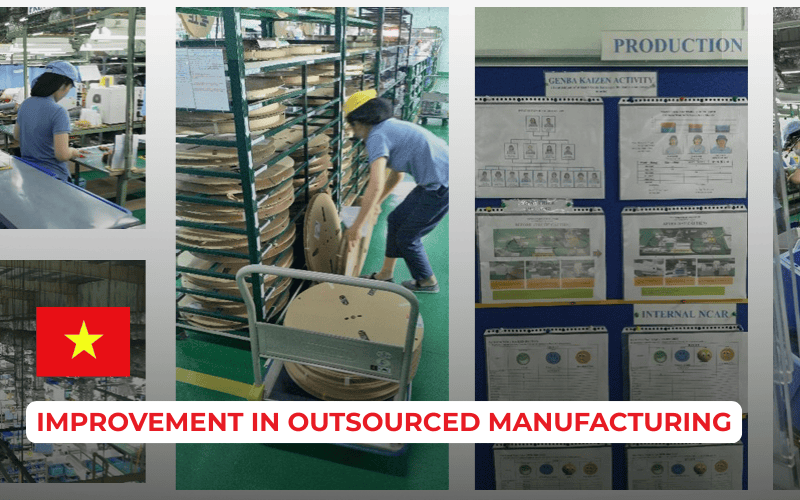
Continuous Improvement in Outsourced Manufacturing
Develop contingency plans for likely crises (supplier failure, quality issues, natural disasters, geopolitical events, demand shocks) with defined trigger criteria, response actions, and crisis teams (coordinator, supply chain lead, quality lead, communications lead, finance lead). Create standardized response playbooks and conduct annual simulation exercises. After crises, conduct post-mortems documenting lessons learned. Track comprehensive KPIs across quality (defect rates, returns, first pass yield), delivery (on-time %, lead time consistency), cost (TCO trends, reductions), flexibility (capacity responsiveness), and innovation (implemented suggestions, time-to-market). Balance leading and lagging indicators; benchmark against industry standards.
Apply lean methodology to eliminate waste through value stream mapping with suppliers. Implement kaizen programs with joint improvement goals (e.g., reduce lead times 20%, improve first pass yield 95% to 98%, cut costs 15% over two years) and 50/50 benefit sharing. Involve suppliers early in product development. Document lessons learned after each project. Invest in training and encourage industry participation to bring back best practices.
Advanced Cost and Financial Management
Calculate total cost of ownership beyond unit price: include tooling, freight, duties, quality inspection, defects/warranty, inventory carrying costs, payment terms impact, and supplier management overhead. A supplier with 5% lower unit price but higher defects or longer lead times may cost more overall. TCO analysis also guides supplier development investments—spending $50,000 to improve supplier quality that saves $200,000 in warranty costs generates substantial returns.
Value engineering through design-for-manufacturing reviews reduces costs by simplifying geometries, reducing part counts, standardizing materials, and loosening unnecessary tolerances. Explore process optimization (casting vs. machining, automated vs. manual assembly) and material substitutions. Conduct collaborative workshops with suppliers who often see cost reduction opportunities you miss. Request open-book accounting showing labor, materials, overhead, and margins—transparency enables joint cost reduction with 50/50 benefit sharing. For currency risk, use forward contracts for significant exposure or consult treasury specialists.
Technology Integration (Industry 4.0)
Integrate digital systems for unprecedented visibility: ERP systems connect sales through production to delivery, MES monitors production floor activities in real-time, and PLM manages product data from design to end-of-life. Work with suppliers to integrate systems enabling automated order processing and real-time status visibility. IoT sensors embedded in equipment enable predictive maintenance, process optimization, and quality correlation with parameters. Start with pilot projects in critical areas, prove value, then expand.
Advanced analytics and machine learning identify subtle quality issues before they escalate, predict equipment maintenance needs, optimize production schedules, and improve demand forecasting. Predictive quality systems use sensor and inspection data to adjust processes proactively. Cloud-based collaboration platforms provide single sources of truth for specifications and quality data. Real-time dashboards accessible to both parties enable faster problem resolution. Video collaboration reduces travel needs while maintaining face-to-face connection through virtual factory tours and remote inspections.
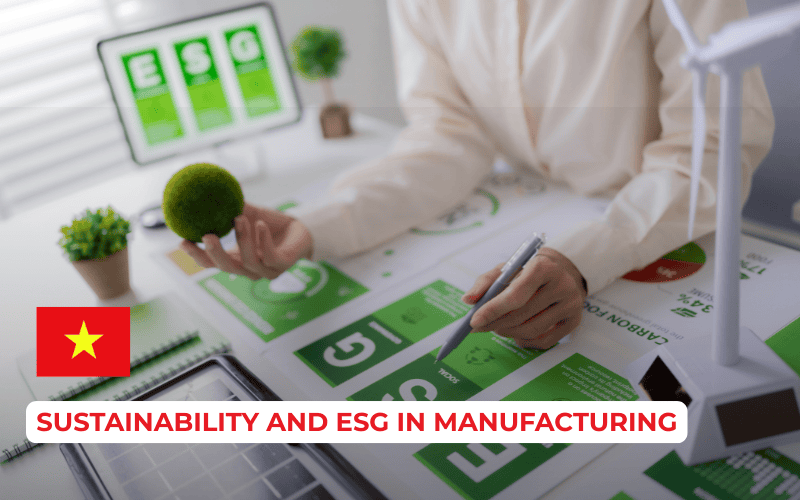
Sustainability and ESG in Vietnam Manufacturing
Vietnam’s environmental regulations require compliance with wastewater treatment, air emissions, solid waste management, and hazardous materials handling—violations risk fines, shutdowns, or criminal liability. Beyond compliance, proactive environmental management reduces costs through energy efficiency, water conservation, and waste reduction. Require ISO 14001 certification or industry-specific environmental standards. Conduct regular social compliance audits (SA8000, BSCI, WRAP standards) addressing working conditions, fair wages, reasonable hours, and prohibition of child/forced labor. Address violations proportionally—minor issues require improvement plans, serious violations like child labor trigger immediate disqualification.
Green industrial parks offer central wastewater treatment, renewable energy, and recycling systems, simplifying compliance despite slightly higher costs. Develop systems for supply chain transparency disclosing manufacturing locations, labor practices, environmental impacts, and material sourcing—transparency builds trust in sustainability-conscious markets. Blockchain and emerging technologies enable tamper-proof tracking for proving authenticity and ethical sourcing. Encourage suppliers to provide good working conditions, skills development, and career advancement—better labor practices minimize turnover and improve quality.
Contract Negotiation and Management
Sophisticated contracts create aligned incentives and manage risks through strategic terms.
Tiered Pricing and Volume Commitments
Structure tiered pricing with volume thresholds (e.g., $5.00/unit for 0-5,000 units, $4.50 for 5,001-15,000, $4.00 for 15,000+) incentivizing growth while enabling supplier planning. Minimum volume commitments provide supplier confidence for investments while securing your pricing, with flexibility provisions for market downturns.
Performance Incentives and SLAs
Align supplier motivation through bonuses for exceeding targets (quality below defect thresholds, on-time delivery above 95%, implemented cost reductions, innovation contributions). Define quantitative Service Level Agreements for delivery rates, quality levels, response times, and lead times. Balance incentives for excellence with consequences for underperformance.
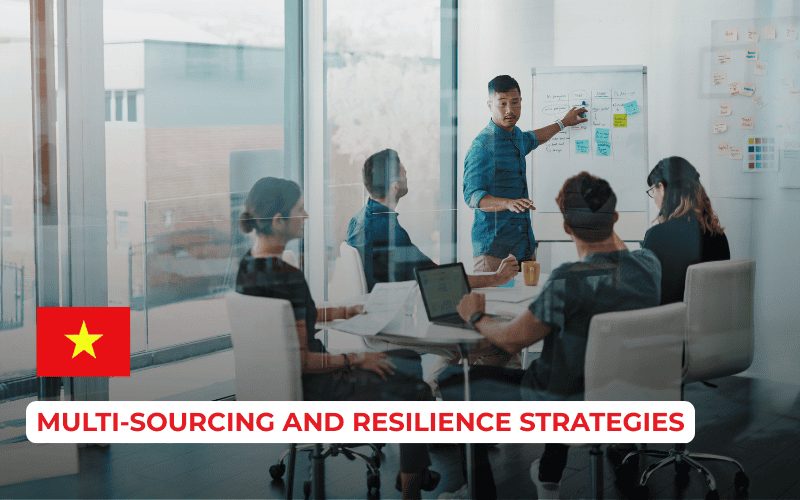
Multi-Sourcing and Resilience Strategies
Concentrating manufacturing in a single location creates vulnerability to country-specific risks—political changes, trade policy shifts, natural disasters, infrastructure failures, or pandemic responses. Geographic diversification spreads risk: combine Vietnam for cost-sensitive, labor-intensive products with Thailand/Malaysia for higher-complexity manufacturing and selective China production where supply chain depth remains unmatched. “Vietnam plus one” or “Vietnam plus two” approaches maintain significant Vietnam production while qualifying alternative locations for rapid scaling when needed.
Within Vietnam, avoid over-concentration with single suppliers by qualifying multiple vendors and splitting production based on their strengths (Supplier A for precision, Supplier B for high-volume cost-sensitive work). Dynamic load balancing shifts production among qualified suppliers based on capacity, performance, pricing, and risk conditions—perhaps 70% primary, 30% backup normally, with flexibility to adjust quickly. Maintain backup suppliers through annual tooling maintenance fees, periodic small orders, and regular audits. Document complete production transfer packages with specifications, quality standards, and key parameters. Test transferability periodically through small runs at backup facilities.
Conclusion: Achieving Excellence in Outsourced Manufacturing
Excellence in outsourced manufacturing isn’t achieved through any single practice but through systematic implementation of comprehensive management approaches across quality, risk, relationships, cost, technology, sustainability, and continuous improvement.
From Friction to Partnership
The journey from basic transactional relationships to strategic partnerships represents fundamental transformation. Early supplier relationships often feel adversarial—negotiating hard on price, catching quality issues reactively, and managing constant surprises. Mature partnerships feel collaborative—solving problems jointly, improving processes together, and creating value for both parties.
This transformation requires investment and commitment. Invest time in supplier development. Share information more openly. Make long-term commitments. Treat supplier success as interconnected with your own. The returns from strategic partnerships—better quality, lower total costs, faster innovation, greater flexibility—far exceed the investments required.
Continuous Adaptation
Manufacturing environments change constantly. New technologies emerge, markets shift, competitors evolve, regulations change, and risks evolve. Excellence requires continuous adaptation rather than assuming today’s approaches remain optimal indefinitely.
Build learning and adaptation into your operating rhythms. Regular business reviews with suppliers should examine not just current performance but changing conditions requiring new approaches. Annual strategic planning should challenge assumptions about manufacturing strategies and supplier relationships.
Stay informed about industry trends, technological advances, and best practices through industry participation, continuous education, and professional networks. Manufacturing excellence is a journey of continuous learning and improvement, not a destination.
Value Creation
Ultimately, manufacturing excellence creates value for your business through cost advantages that improve profitability or enable competitive pricing, quality excellence that reduces warranty costs and builds brand reputation, flexibility and responsiveness that enable faster time-to-market and better customer service, innovation that differentiates products and creates new opportunities, and resilience that maintains operations when competitors struggle.
These value creation opportunities justify the investments in advanced management practices outlined throughout this guide. Companies that excel at outsourced manufacturing gain sustainable competitive advantages that support business growth and market leadership.
Your path forward depends on your current state and priorities. Conduct honest assessment of strengths and gaps across quality management, risk management, supplier relationships, cost optimization, technology integration, sustainability, contract management, supply chain resilience, crisis preparedness, and continuous improvement.
Prioritize improvements based on impact and feasibility. Quick wins that deliver value rapidly build momentum. Strategic initiatives requiring longer timeframes should proceed in parallel, building capabilities that deliver major value over time.
Success requires leadership commitment, resource investment, and cultural change. Executives must champion manufacturing excellence as strategic priority. Invest in people, systems, and supplier development. Build organizational culture that values quality, continuous improvement, and collaborative partnerships.
The path to manufacturing excellence is challenging but achievable. Thousands of companies have transformed outsourced manufacturing from sources of constant problems into strategic advantages supporting growth and competitive success. With systematic implementation of the advanced strategies outlined in this guide, your organization can achieve world-class manufacturing operations that create sustained value and competitive advantage.