Where to Manufacture in 2026? Vietnam, Malaysia, Thailand, Indonesia and the Rise of Multi-Hub Production
Global manufacturing is undergoing a profound structural transformation. As companies approach 2026, long-standing production models built around single-country dependence are giving way to more complex and resilient frameworks. The central challenge for manufacturers is no longer whether diversification is necessary, but how to design a multi-hub manufacturing footprint that can simultaneously control costs, manage risk, meet rising compliance standards, and scale efficiently across markets.
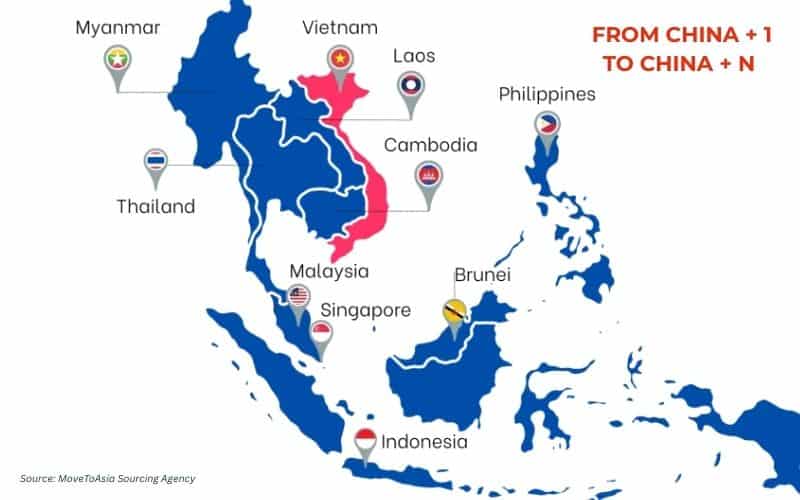
What initially emerged as a cautious contingency, commonly referred to as the “China+1” strategy, has matured into a far broader approach to global production. Today, companies are assembling interconnected manufacturing networks that span multiple alternative manufacturing countries, particularly across Southeast Asia. Within this evolving architecture, Vietnam, Malaysia, Thailand, and Indonesia have become critical pillars, each playing a distinct role based on industrial capabilities, workforce specialization, infrastructure maturity, and risk considerations.
This article explores where to manufacture in 2026, how these countries compare, and how companies are redesigning production networks to remain competitive in an increasingly volatile global environment.
Why Manufacturing Location Decisions Are Changing in 2026
For decades, manufacturing decisions were driven primarily by cost efficiency and scale. That model is rapidly becoming outdated. By 2026, companies must navigate a far more complex landscape shaped by geopolitical tensions, trade regulations, ESG requirements, labor constraints, and supply-chain fragility.
Manufacturers are responding by distributing production across multiple countries instead of concentrating output in a single hub. This approach reduces exposure to localized disruptions, enables faster regional market access, and improves long-term resilience.
Southeast Asia has become central to this shift. Countries in the region offer competitive labor costs, expanding industrial ecosystems, improving infrastructure, and strong integration into global trade agreements. However, they are not interchangeable. Each country plays a different role within a diversified manufacturing strategy.
Manufacture in Vietnam: The Backbone of Asia’s Diversified Supply Chains
Vietnam has firmly positioned itself as one of the most strategic manufacturing destinations in Asia. For companies looking to manufacture in Vietnam, the country offers a compelling mix of cost competitiveness, industrial depth, and trade connectivity.
Vietnam excels in:
Furniture and wood products
Textiles, garments, and footwear
Light industrial and assembled products
Electronics and electronic components
Consumer goods and household products
Its manufacturing ecosystem has matured significantly. Many factories now operate with international quality standards, structured quality-control systems, and experience working with global brands. Vietnam is particularly attractive for companies relocating or duplicating production previously concentrated in China.
Rather than replacing China, Vietnam often functions as a complementary manufacturing hub, absorbing labor-intensive assembly, final manufacturing stages, or export-oriented production. Trade agreements such as the EVFTA and CPTPP further enhance Vietnam’s attractiveness by reducing tariffs and providing preferential access to major markets.
This makes Vietnam a cornerstone of multi-hub production models heading into 2026, especially for companies operating in electronics, consumer products, and export-oriented sectors.
Manufacture in Malaysia: Precision, Compliance, and High-Value Manufacturing
To manufacture in Malaysia is to prioritize quality, compliance, and technical capability over pure cost minimization. Malaysia plays a distinct role within diversified supply chains, particularly for more complex or regulated products.
Malaysia is well-suited for:
Electronics and semiconductors
Medical devices
Electrical equipment
Automotive components
Precision manufacturing
Labor costs in Malaysia are higher than in Vietnam or Indonesia, but this is offset by higher productivity, stronger protection of intellectual property, and a highly skilled technical workforce. The country’s regulatory environment and infrastructure make it especially attractive for companies that require tight process control, traceability, and compliance with global quality standards.
Malaysia’s industrial parks and technology zones have attracted significant investment from multinational corporations, further strengthening the ecosystem for advanced manufacturing. As a result, companies that choose to manufacture in Malaysia often benefit from robust supplier networks and a high degree of operational reliability.
Manufacture in Thailand: Industrial Depth and Automotive Strength
Thailand remains one of Southeast Asia’s most established industrial economies. It offers a highly developed supplier base and strong manufacturing know-how, particularly in capital-intensive sectors.
Thailand is a strong choice for:
Automotive and auto parts
Machinery and industrial equipment
Electronics and appliances
Food processing and packaging
The country’s long manufacturing history translates into stable supply chains and experienced industrial operators. While labor costs are higher than in Vietnam or Indonesia, Thailand compensates with reliability, consistency, and scale. This is particularly important for sectors such as automotive, where supplier depth and technical competence are critical for long-term production success.
Thailand’s infrastructure, including ports, roads, and logistics services, is also more mature than in many regional peers, making it easier to integrate into global shipping networks. For companies that require scale and industrial robustness, Thailand frequently serves as a critical anchor in multi-hub manufacturing strategies.
Manufacture in Indonesia: Scale and Resource Advantage
When evaluating the best product to manufacture in Indonesia, scale and resource access are key considerations. Indonesia’s large population, abundant natural resources, and rapidly growing industrial base make it increasingly attractive for specific product categories.
Indonesia performs well in:
Footwear and apparel
Furniture and wood-based products
Consumer goods
Rubber- and resource-based manufacturing
Entry-level electronics assembly
Indonesia’s domestic market size also offers opportunities for companies producing both for export and local consumption. Its strategic geographic position, combined with competitive labor rates and natural resource availability (such as rubber and timber), makes Indonesia a natural choice for certain manufacturing segments.
However, manufacturing in Indonesia often requires strong local expertise, as regulatory complexity, infrastructure disparities, and supplier variability can pose challenges. When executed well, Indonesia can serve as a volume-driven manufacturing hub within a broader multi-hub production network, particularly for labor-intensive goods where scale is essential.
Alternative Manufacturing Countries and the Multi-Hub Model
The rise of alternative manufacturing countries is not about choosing a single “next China.” Instead, it reflects a structural shift toward distributed production networks.
By 2026, many global manufacturers operate across:
China (for scale, upstream supply, and advanced processes)
Vietnam (for assembly, export manufacturing, and cost efficiency)
Malaysia (for precision and compliance-heavy production)
Thailand (for industrial and automotive production)
Indonesia (for volume and labor-intensive goods)
This multi-hub production model allows companies to rebalance output dynamically, shift volumes during disruptions, and align production with regional demand. A diversified manufacturing footprint also supports risk mitigation by reducing overdependence on any one country or supplier.
Furthermore, nearshoring trends in Europe and North America are strengthening alternative hubs within those regions, such as Eastern Europe and Mexico, but Southeast Asia remains central for many export-led strategies due to its demographic and economic growth prospects.
Speed to Market: Turnkey Factories and Phased Scaling
Another defining trend shaping where to manufacture in 2026 is the preference for speed and flexibility. Companies increasingly favor:
Ready-built factories
Contract manufacturing
Small-batch pilot production before scaling
This phased approach reduces capital risk and enables faster market entry. Southeast Asian countries, particularly Vietnam and Malaysia, now offer industrial parks and turnkey manufacturing solutions designed to support this model.
Rather than committing immediately to greenfield investments, companies can test, validate, and scale production with far greater agility. This is especially valuable in sectors with fast product cycles, high customization demands, or uncertain demand forecasts.
Compliance, Audits, and Transparency as Location Drivers
Manufacturing location decisions are not purely operational. Compliance, ESG, and traceability requirements are now central to sourcing strategies.
When selecting where to manufacture, companies increasingly assess:
Audit readiness and factory transparency
Labor and environmental compliance
Traceability of raw materials and subcontractors
Ability to meet destination-market regulations
Countries with stronger regulatory frameworks and experienced export manufacturers gain an advantage. This is one reason Vietnam, Malaysia, and Thailand continue to attract manufacturing investment despite rising costs.
Risks and Trade-Offs in Multi-Country Manufacturing
While multi-hub production improves resilience, it also introduces complexity. Managing multiple countries means dealing with:
Different regulatory systems
Varying quality standards
Communication and coordination challenges
Increased oversight requirements
Without proper governance, diversification can create inefficiencies rather than reduce risk. Successful companies invest heavily in supplier vetting, audits, local teams, and quality management systems to ensure consistency across hubs.
Governance frameworks, centralized data flows, and standardized audit practices help maintain oversight while allowing localized exécution, a necessity in the multi-hub world.
How Companies Should Decide Where to Manufacture in 2026
There is no universal answer to where to manufacture in 2026. The optimal setup depends on product type, risk tolerance, compliance requirements, and long-term strategy.
However, clear patterns are emerging:
Vietnam as a core export and assembly hub
Malaysia for high-value and regulated manufacturing
Thailand for industrial and automotive production
Indonesia for scale-driven, labor-intensive goods
The most competitive companies are those that design intentional, multi-hub manufacturing architectures rather than reactive relocations.
Conclusion: Manufacturing in 2026 Is About Architecture, Not Location
By 2026, manufacturing success will not be defined by choosing the cheapest country. It will depend on how well companies architect diversified, resilient, and compliant production networks.
Vietnam, Malaysia, Thailand, and Indonesia are not competitors in a zero-sum game. They are complementary nodes in a broader manufacturing ecosystem that reflects the realities of global risk, regulation, and market volatility.
For companies willing to invest in governance, visibility, and long-term partnerships, Southeast Asia offers some of the most compelling manufacturing opportunities in the world, not as a single alternative, but as a strategic multi-hub solution.
In an era of uncertainty, multi-hub production is not just a competitive advantage; it is a new baseline for supply-chain success.