SMT Automation vs. Manual Assembly in Vietnam’s Electronics Manufacturing
Vietnam has become one of the most attractive electronics manufacturing destinations in Southeast Asia. Driven by strong foreign direct investment, a growing supplier ecosystem, and increasing demand from international companies looking for China+1 manufacturing strategies, the country has developed significant capabilities in electronics assembly and contract manufacturing.
As electronic products become smaller, smarter, and more complex, manufacturers are investing heavily in Surface Mount Technology (SMT) automation. Modern SMT production lines enable factories to assemble thousands of components with high levels of speed, accuracy, and repeatability. For high-volume electronics production, automation has become an essential capability.
However, the idea that modern electronics factories are fully automated is not accurate. In reality, even advanced PCB assembly facilities continue to combine automated production technologies with skilled manual operations.
Many electronic products still require human expertise for processes that cannot be efficiently automated, including the installation of large connectors, through-hole components, cable assemblies, mechanical parts, and customized product configurations.
For OEMs evaluating electronics manufacturing partners in Vietnam, the key consideration is not whether a supplier uses automation or manual assembly. The more important question is whether the manufacturer has the right balance between automation, skilled operators, quality control systems, and production flexibility.
The most reliable electronics manufacturers are not necessarily those with the highest level of automation, but those that can successfully integrate technology, people, and processes to consistently deliver quality products.
Why SMT Automation Is Growing in Vietnam
The growth of Vietnam’s electronics manufacturing industry has accelerated the adoption of SMT automation. As global brands expand their supply chains into Southeast Asia, Vietnamese suppliers are increasingly required to meet higher expectations for production capacity, quality consistency, and manufacturing efficiency.
Surface Mount Technology (SMT) has become a fundamental part of modern PCB assembly because it enables manufacturers to place extremely small electronic components with high speed and precision while maintaining consistent production quality.
Compared with manual component placement, automated SMT production offers several important advantages, including higher production speed, greater placement accuracy, improved process repeatability, better manufacturing scalability, and more consistent product quality.
Modern electronic products such as smartphones, industrial control systems, automotive electronics, medical devices, and IoT equipment often contain hundreds or even thousands of components mounted on a single PCB. Performing these operations manually would be both inefficient and difficult to maintain at a consistent quality level.
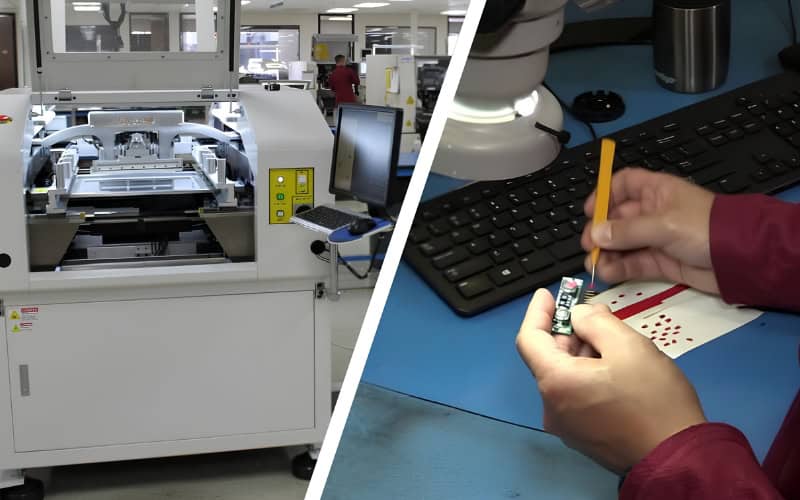
A typical SMT production line includes several automated stages, including solder paste printing, high-speed component placement, reflow soldering, and automated inspection. Together, these processes enable manufacturers to assemble complex PCBAs with a high degree of precision and efficiency.
To better understand how an SMT production line operates in practice, watch the short video below. It demonstrates the key stages of PCB assembly, providing a practical overview of how modern electronics manufacturers achieve consistent production quality.
▶ Video: SMT PCB Assembly Process
During solder paste printing, machines precisely apply solder paste onto PCB pads according to the product design. High-speed pick-and-place machines then position surface-mounted components with extremely high accuracy before the boards move through the reflow soldering process, where controlled heating permanently bonds the components to the PCB.
After assembly, Automated Optical Inspection (AOI) systems identify visible defects such as misplaced components, soldering issues, or missing parts before the boards proceed to additional verification stages.
These automated processes allow Vietnamese electronics manufacturers to produce increasingly sophisticated electronic assemblies while maintaining stable production performance.
However, the value of automation extends beyond production speed. One of its greatest advantages is reducing process variation. In high-volume manufacturing, automated equipment performs repetitive tasks with the same level of precision across thousands—or even millions—of production cycles, helping minimize human error and improve overall product reliability.
For international OEMs, this consistency provides greater confidence that products manufactured in Vietnam can meet global quality expectations.
At the same time, automation has its limitations. Not every product design or manufacturing requirement can be efficiently handled by machines alone. This is why skilled manual assembly continues to play an important role in modern electronics manufacturing.
Why Manual Assembly Remains Important
Despite continuous advances in SMT technology, manual PCB assembly remains common in Vietnam’s electronics manufacturing industry.
This does not indicate a lack of manufacturing capability. Instead, it reflects the reality that many electronic products require flexibility, customization, and specialized handling that automation cannot always provide efficiently.
SMT equipment is highly effective for placing small surface-mounted components. However, many products still include components that require manual installation or additional processing.
These may include large connectors, transformers, high-power components, heat sinks, cable assemblies, mechanical parts, and through-hole components.
Through-hole technology (THT), for example, continues to be widely used in applications where mechanical strength and durability are important. Components inserted through holes in the PCB often provide stronger physical connections compared with surface-mounted alternatives.
This is particularly relevant in industries such as:
Industrial automation
Power electronics
Automotive systems
Medical equipment
Telecommunications infrastructure
These sectors often prioritize long-term reliability and operational durability rather than only maximizing production speed.
Vietnam’s electronics manufacturing environment also includes many high-mix production programs, where manufacturers produce different products in smaller quantities rather than only large-volume consumer electronics.
For these projects, full automation may not always be the most efficient solution. Developing customized automation equipment requires significant investment in tooling, programming, and production setup. When product designs frequently change or production volumes are limited, skilled manual assembly can provide greater flexibility and faster response times. This is especially important during New Product Introduction (NPI) stages, where companies need to validate designs, produce prototypes, and make engineering adjustments before entering mass production.
Many electronics manufacturers in Vietnam support both automated SMT production and manual assembly capabilities because international customers increasingly require flexibility rather than only manufacturing scale.
The ability to combine automation with skilled labor allows suppliers to support a wider range of projects, from high-volume electronics production to customized industrial applications.
Manual PCB Assembly
Vietnam’s Advantage: A Hybrid Manufacturing Model
One of Vietnam’s greatest strengths in electronics manufacturing is its ability to combine advanced SMT automation with a skilled and adaptable workforce.
Rather than choosing between fully automated production and manual assembly, many manufacturers operate a hybrid manufacturing model that leverages the advantages of both. Automation delivers speed, accuracy, and consistency for repetitive processes, while experienced operators handle specialized tasks that require flexibility, judgment, or product-specific adjustments.
This balanced approach is particularly valuable for international companies outsourcing production to Vietnam. While high-volume consumer electronics benefit from highly automated SMT lines, many industrial products require additional manual operations during final assembly. Cable harness installation, enclosure integration, connector assembly, conformal coating, and product customization are common examples where skilled technicians continue to play an essential role.
The hybrid model also supports one of Vietnam’s competitive advantages: manufacturing flexibility.
Unlike factories dedicated exclusively to very high-volume production, many Vietnamese EMS providers can support a broader range of manufacturing requirements. They are able to produce prototypes, pilot batches, low-volume industrial products, and high-mix manufacturing programs alongside larger production runs.
This flexibility is particularly valuable during the New Product Introduction (NPI) stage. Engineering teams often need to validate designs, modify prototypes, and optimize production processes before a product enters mass production. During this phase, combining automated SMT assembly with controlled manual operations allows manufacturers to respond more quickly to engineering changes while maintaining production quality.
For OEMs, the value of this hybrid approach extends beyond operational flexibility. It enables manufacturers to support a wider variety of products without compromising quality, making Vietnam an attractive destination for both established production programs and new product development.
Managing Manual Assembly Quality
The presence of manual assembly should not automatically be viewed as a manufacturing weakness. In many cases, it is a necessary part of producing complex electronic products. The real differentiator is how effectively those manual processes are controlled.
Professional electronics manufacturers treat manual assembly with the same level of discipline applied to automated production. Every operation follows documented procedures designed to ensure consistency regardless of which operator performs the task.
This typically includes standardized work instructions, clearly defined assembly procedures, operator qualification programs, and regular skills assessments. Visual guides and production documentation help reduce variation while ensuring that every assembly step follows the same quality requirements.
International workmanship standards also play an important role. Many manufacturers producing for export follow IPC-A-610 for electronic assembly acceptability and IPC J-STD-001 for soldering processes. These standards provide objective quality criteria and help ensure consistent workmanship across production lines.
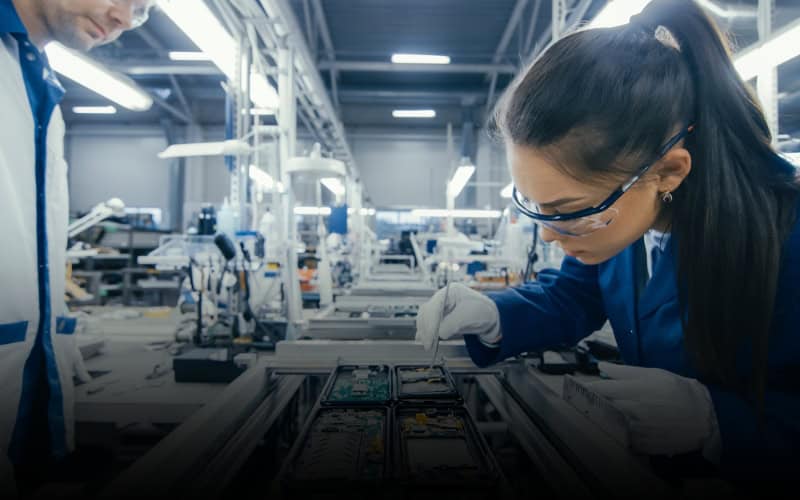
Training is equally important. Although automation has reduced the amount of manual work required during production, skilled operators remain essential for soldering, mechanical assembly, rework, inspection, and product verification. Continuous training and certification help manufacturers maintain a consistent level of workmanship as production requirements evolve.
Ultimately, manual assembly becomes a competitive advantage when supported by standardized processes, experienced personnel, and a strong quality management system.
Inspection, Testing, and Traceability
Regardless of how much automation is used during production, quality must be verified before products leave the factory.
Modern electronics manufacturers in Vietnam typically implement multiple inspection and verification stages throughout the production process rather than relying on a single final inspection. Each stage is designed to identify different types of defects and reduce the risk of quality issues reaching the customer.
Visual inspection remains the first level of verification, while Automated Optical Inspection (AOI), X-ray inspection, electrical testing, functional verification, and First Article Inspection (FAI) provide additional assurance depending on product complexity and customer requirements.
Functional verification is particularly important because a PCB can appear to be assembled correctly while still failing under real operating conditions. Firmware issues, communication failures, signal integrity problems, or software integration errors may only become apparent when the complete assembly is powered on and tested as a working system.
In addition to inspection, traceability has become an increasingly important requirement for international OEMs.
Many electronics manufacturers in Vietnam now use Manufacturing Execution Systems (MES) and digital quality management platforms to record production activities throughout the manufacturing process. These systems create a digital record of each product, including production dates, operator information, inspection results, machine parameters, component batches, and process history.
When quality issues occur, this information allows engineers to perform root cause analysis much more quickly and identify corrective actions before defects affect larger production volumes.
For buyers, traceability offers more than operational visibility. It demonstrates that a supplier has established disciplined production controls and can provide documented evidence of quality throughout the manufacturing process.
As Vietnam continues to move into higher-value electronics manufacturing, digital traceability is becoming an important capability for suppliers serving automotive, industrial, medical, and other quality-sensitive industries.
What OEM Buyers Should Evaluate When Selecting a Vietnam PCB Assembly Partner
When selecting a PCB assembly supplier in Vietnam, evaluating production capacity alone is no longer sufficient. A modern SMT production line is important, but reliable manufacturing depends on the entire quality management system rather than equipment alone.
OEMs should evaluate whether a supplier can demonstrate:
Modern SMT production capabilities appropriate for the product.
Experience manufacturing similar PCB assemblies or serving the same industry.
Quality management systems such as ISO 9001 and compliance with relevant IPC standards.
Appropriate inspection and verification processes, including AOI, functional testing, ICT, or other methods required by the application.
Manufacturing traceability through MES or equivalent production management systems.
Engineering support during prototype development and New Product Introduction (NPI).
The ability to support both high-volume production and lower-volume, high-mix manufacturing when required.
A structured approach to operator training, process documentation, and continuous improvement.
Rather than asking whether a factory performs manual assembly, buyers should ask how those manual operations are managed, inspected, and documented. In many cases, a manufacturer with well-controlled manual processes will deliver more consistent results than one that relies heavily on automation without robust quality systems.
Ultimately, the best manufacturing partner is the one that can consistently deliver products that meet technical specifications, production schedules, and long-term reliability expectations.
Conclusion
SMT automation has transformed electronics manufacturing by improving production speed, accuracy, and consistency. It has enabled manufacturers in Vietnam to produce increasingly sophisticated electronic products while meeting the quality expectations of global customers.
At the same time, manual assembly continues to play an important role in modern PCB manufacturing. Through-hole components, customized industrial products, prototype development, and specialized mechanical assemblies often require the expertise of skilled technicians. Rather than replacing people, automation has changed how people contribute to the manufacturing process.
The most successful electronics manufacturers in Vietnam understand that reliable production depends on more than advanced machinery. It requires a balanced combination of automation, skilled operators, standardized processes, comprehensive inspection, and digital traceability.
For OEMs sourcing PCB assemblies in Vietnam, evaluating a supplier should extend beyond the number of SMT lines or production capacity. A manufacturer’s engineering capability, quality management system, inspection procedures, and ability to control both automated and manual processes are equally important indicators of long-term manufacturing performance.
As Vietnam continues to strengthen its position as a global electronics manufacturing hub, companies that successfully integrate technology, people, and disciplined production systems will be best positioned to support international customers and deliver reliable, high-quality products.